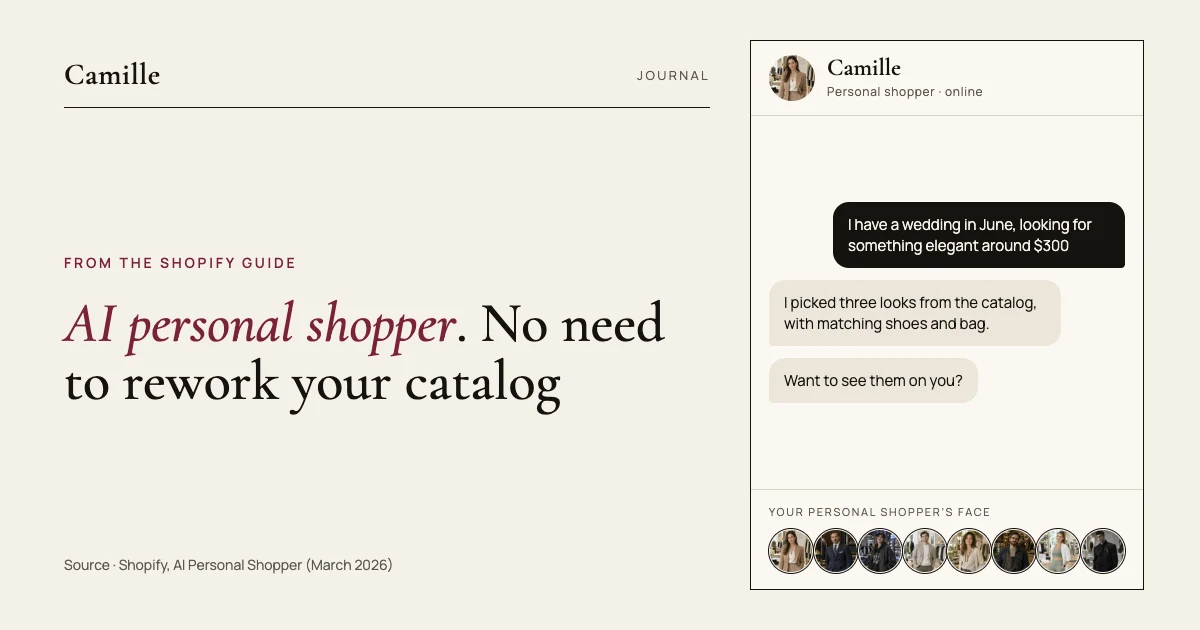
An AI personal shopper is an assistant that helps shoppers find and buy products through conversation, instead of searching by keyword. Shopify wrote a guide about it, AI Personal Shopper: How AI Agents Can Help Customers Shop, published in March 2026. Here we sum up the key points for anyone running a fashion store, and add one thing the guide doesn’t say. To bring Camille into your store, you don’t need to reorganize your catalog.
What is an AI personal shopper, according to Shopify?
It is a virtual assistant that helps shoppers find and buy products through a conversation, typed or spoken. It can live on the store’s own site or on outside platforms like ChatGPT.
The difference from classic search, the Shopify guide explains, is that the assistant doesn’t look for exact words. It tries to understand the intent behind the question and suggests the products that fit best. For logged-in customers it can also use purchase history, and for everyone else it works from what they are browsing right now.
How is it different from a chatbot?
A traditional chatbot follows a script and answers predictable questions like order status or returns. An AI personal shopper understands what the shopper is looking for, asks clarifying questions and makes recommendations based on what has already been said.
Shopify puts it this way. When a shopper goes off the expected keywords, a rule-based chatbot hits a dead end. An AI assistant keeps the conversation going, the way a person in a store would.
What can an AI personal shopper do for a store?
According to Shopify, there are three main use cases. Personalized product discovery, styling and curation, and consultative selling available around the clock.
To support the first point, the guide cites research from Epsilon finding that 80% of consumers are more likely to buy from a brand that offers a personalized experience. It also mentions a case reported by McKinsey, a lifestyle company that saw conversion rates rise by up to 20% after adding a generative AI shopping assistant. These are other people’s figures, reported by Shopify, and should be read as industry signals.
For fashion, the most interesting part is styling. Instead of browsing one category after another, the shopper describes what they need and gets suggestions that are already filtered. It is what a great sales associate does when someone walks in with an occasion in mind.
What does Shopify recommend to be found by outside AI assistants?
Shopify suggests four changes to the catalog, aimed at showing up in answers from ChatGPT, Gemini and other assistants. Concrete descriptions, clear photos, detailed reviews and structured data.
In short, from the Shopify guide.
- Descriptions with concrete facts (material, use, the problem the piece solves) instead of slogans.
- Photos with accurate colors and the product in context, because AI reads images too.
- Specific reviews that say something useful about the product.
- Structured data (schema markup), a reliable source of truth with FAQs and policies, and a connection to AI channels through Agentic Storefronts.
This work is worth doing, especially if you want to be found outside your own site. We covered it in our article on agentic commerce.
Do you need to reorganize your catalog to have a personal shopper in your store?
For many apps, yes, and it is the first step Shopify lists too. With Camille, no, because she analyzes your catalog as it is, without asking you to rewrite descriptions, add attributes or upload any other information.
In the last part of the guide, Shopify explains how to bring an AI assistant into your store in three steps. First, organize the catalog with descriptive titles, clearly defined collections and complete attributes. Then install a conversational app from the Shopify App Store. Finally, train it by uploading guides, FAQs, return policies and brand guidelines.
Here is how the same steps look with Camille.
| The path Shopify describes | With Camille | |
|---|---|---|
| Catalog | Organize it first, with titles, collections and complete attributes | Fine as it is. Camille analyzes it on her own |
| Information to upload | Guides, FAQs, policies and brand guidelines | None to get started |
| What it does with the shopper | Answers and recommends products | Recommends the complete outfit for the occasion, budget, colors and body shape, then shows it on the shopper with virtual try-on |
| Products suggested | Depends on the app | Only pieces from your catalog |
| Cost | From free plans to monthly subscriptions | 300 free credits and no monthly fee |
The catalog work Shopify suggests is still useful for Google and for outside assistants. For Camille, though, it is not a prerequisite. You install her, test her privately on your catalog and decide when your customers get to see her.
Where to start
Read the full Shopify guide if you want to work on visibility in outside AI assistants. It is clear and full of practical examples.
If instead you want to give the shoppers who reach your store a personal shopper who advises like a sales associate and closes with virtual try-on, you can start today, with the catalog you already have.
Install Camille free on Shopify or try her on our demo store.
FAQ
What is an AI personal shopper?
It is an assistant that helps a store’s shoppers find and buy products through a conversation. Unlike classic search, it tries to understand the intent behind the question and suggests the most suitable products.
What is the difference between an AI personal shopper and a chatbot?
A traditional chatbot follows a script and answers predictable questions about returns and shipping. An AI personal shopper understands what the shopper is looking for, asks clarifying questions and recommends products based on the conversation.
Do I need to change my Shopify catalog to use Camille?
No. Camille analyzes your catalog as it is, with no need to rewrite descriptions, add attributes or upload other information. You install her from the Shopify App Store and can test her privately right away.
How much does an AI personal shopper for Shopify cost?
Shopify says prices range from free plans to monthly subscriptions, depending on the app. Camille starts with 300 free credits, then you pay for credit packs, with no monthly fee.
Paolo is CEO of Instamark S.r.l. and founder of Camille, the app that brings an AI personal shopper to fashion ecommerce stores. He writes about technology, conversion and tools that help stores sell more online.
1 thought on “AI personal shopper. What Shopify says and why Camille doesn’t need you to rework your catalog”