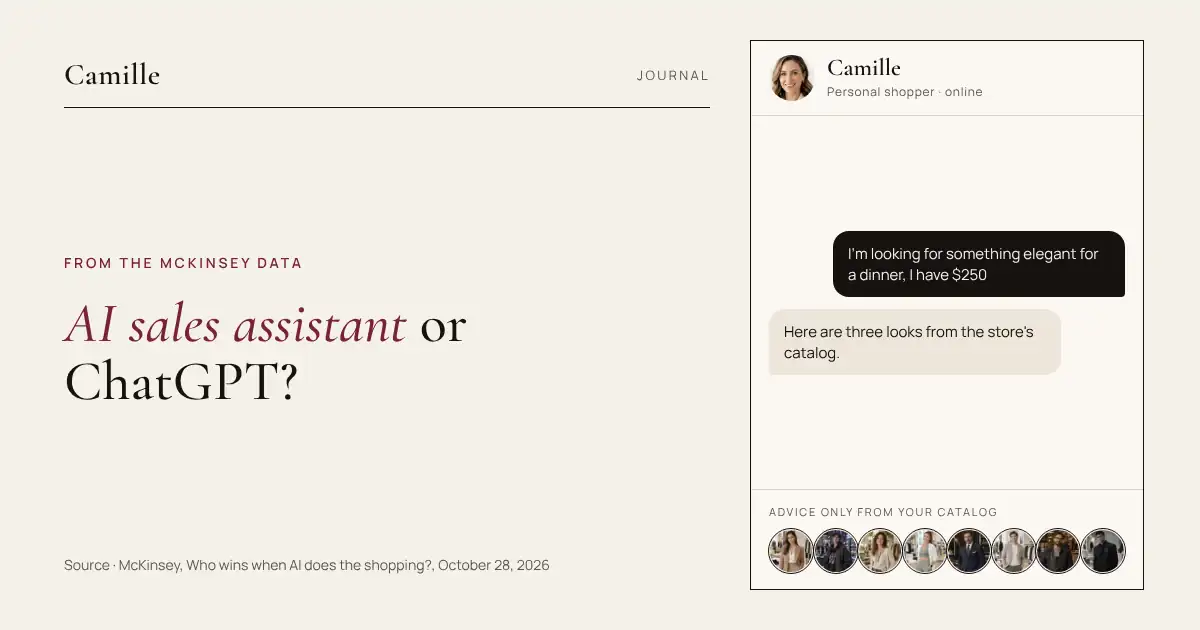
Shoppers use ChatGPT and other general-purpose AI tools far more than retailers’ assistants to discover and compare. At the moment of purchase, according to McKinsey surveys, the two are close, but the retailer group includes the big players, and the data says nothing specific about a fashion store’s own AI sales assistant.
McKinsey is a consulting firm that sells services on these topics, so its numbers should be read as industry signals. The figure on purchases completed directly inside AI tools covers the US only.
What are shoppers doing with AI when they buy?
Many already use it, mostly to compare and research. The closer they get to the cart, the less they use it.
For its article Who wins when AI does the shopping?, published October 28, 2026, McKinsey surveyed about 21,000 consumers in 11 markets in June. 53% had used AI for shopping in the previous three months.
For Europe there is a second McKinsey survey, Europe’s agentic commerce moment, from March 2, 2026, run in France, Germany and the UK. 38% of respondents use AI tools to search for or decide what to buy. Three tasks come up most often (percentages as reported by McKinsey, the base is not stated in the text).
- Comparing brands, models, prices and reviews (63%).
- Learning about a product category (55%).
- Discovering products and finding inspiration (46%).
Use drops as shoppers get closer to the cart and to payment. Apparel is among the categories where shoppers use AI slightly more to inform their decisions.
These are self-reported answers, and each survey covers specific markets. Italy, for example, is not in the sample. Read them as a direction, not as a measure of your own customers.
Are people already buying fashion inside AI tools?
In the US, some AI users are, and apparel leads, narrowly. 18.0% of American AI users completed a purchase of apparel, footwear and accessories directly in an AI tool in the previous three months.
That comes from McKinsey’s chart From prompt to purchase, published November 5, 2026. It is up 8.5 points from December 2025, and other categories sit just below.
Three caveats. It covers American respondents only. It is self-reported. And McKinsey’s “purchase completed with AI” also includes repeat purchases, which the chart page puts at more than half in every category.
For anyone following AI in fashion, it is a signal. It does not say other markets will follow, or when.
Do shoppers use retailers’ AI sales assistants or ChatGPT more?
Along the journey they use general-purpose tools more. At checkout, retailers’ assistants catch up, but that group includes the big players.
According to McKinsey, this is how AI users across the 11 markets split. Retailers’ assistants are the ones built into retailers’ apps and websites.
| Tool | Used in the previous three months | At checkout |
|---|---|---|
| General-purpose tools like ChatGPT | 56% | 14% |
| Retailer AI assistants | 27% | 15% |
In McKinsey’s words, “Retailer AI assistants trail stand-alone AI tools by as much as two times throughout the shopping journey but catch up at checkout.”
Two caveats. The retailer group includes the big players, and on the same page the most used assistant is Amazon’s Alexa for Shopping. McKinsey credits the catch-up at checkout to infrastructure already in place for inventory, payments and delivery, not to an advice assistant. Also, McKinsey notes that the two checkout items were worded differently in the survey, so treat the comparison as an order of magnitude.
In its Q1 2026 results, released May 6, Zalando reports that close to 10 million customers had asked its Zalando Assistant for advice since the start of the year, up from 6 million in all of 2025. That measures use, not sales, and Zalando is a big player. The release does not attribute purchases or revenue to the assistant. It does show that when advice is available inside the store, many customers ask for it.
Why does advice matter more than automated buying?
Because trust follows help, not delegation. In McKinsey’s survey of France, Germany and the UK, trust is higher when AI summarizes reviews, compares and recommends. It is lower when AI prefills the basket, completes checkout or reorders items automatically. McKinsey sums it up this way. “Consumers are not rejecting AI judgment; they are resisting unbounded authority.” The finding is about AI in general, not about any single store’s assistant.
So for a fashion store, the question is still open. The data does not say whether an assistant inside your store holds its own against ChatGPT. What matters is what it can do with your catalog. A general-purpose assistant can suggest pieces from any online store. One inside your store recommends from the pieces you actually carry.
That is the idea we built Camille on. Shoppers write to her the way they would talk to a sales associate. She starts from the shopper’s occasion, budget, colors and body shape, and suggests a complete outfit, chosen only from the store’s catalog. Based on colors and body shape, she explains why a piece works for the person or doesn’t. At the end of the consultation, the shopper sees the outfit on themselves, on their own photo, with virtual try-on.
What can you do on Monday morning?
Three things, with or without Camille. Read your customers’ questions, check your catalog data, and test an assistant in private before showing it to anyone.
- Reread what customers ask in chat or on WhatsApp. The questions they ask before buying tell you their occasions, budgets and doubts.
- Check prices, availability and descriptions in your catalog. Every assistant, inside your store or outside it, reads your product data. If a price is wrong or a sold-out piece shows as available, the advice will be wrong too.
- Test an assistant in private preview. Before customers see it, ask it their questions about your catalog. Check whether it suggests pieces you actually carry and whether it explains why.
If you also want to work on how your store shows up in outside assistants, we covered it in our article on agentic commerce.
How do you start a test?
With a real request from your customers, like an elegant look for a dinner on a $250 budget. Give it to every assistant you are considering and see what it suggests from your catalog.
If you want to know what Shopify recommends about AI shopping assistants, we summarized it in our article on the Shopify guide.
With Camille, you run that test on your own catalog, in private. You try her first, then decide who sees her. You get 300 free credits when you install, with no monthly fee.
Install Camille free on Shopify or try her on our demo store.
FAQ
Is an AI assistant in my store better than ChatGPT?
They do different jobs. ChatGPT is used more to discover and compare. At checkout, according to McKinsey, retailers’ assistants catch up, big players included. For a fashion store, what matters is what the assistant can do with the catalog.
Do these numbers apply to every market?
No. The McKinsey surveys cover only some markets, and Italy, for example, is not in the sample. The figure on buying fashion directly inside AI tools is US only.
Do I need to fix my catalog to use Camille?
No. Camille analyzes your Shopify catalog as it is. You don’t need to reorganize it, rewrite descriptions or add attributes.
Does Camille recommend products from other online stores?
No. She suggests only pieces from the store’s own catalog, the ones the store actually carries.
Paolo is CEO of Instamark S.r.l. and founder of Camille, the app that brings an AI personal shopper to fashion ecommerce stores. He writes about technology, conversion and tools that help stores sell more online.