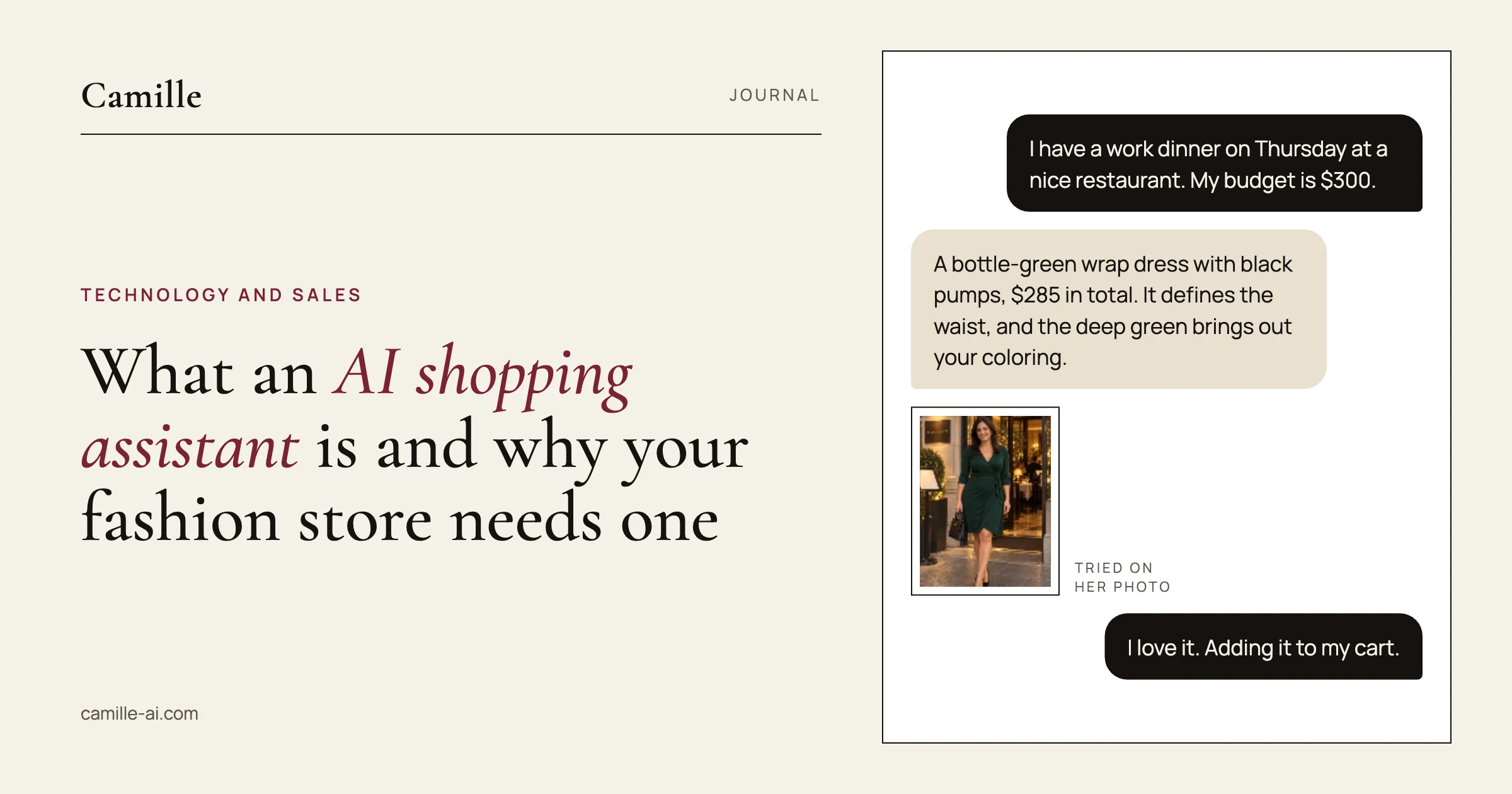
An AI shopping assistant is a chat inside your store that helps customers choose what to buy, the way a good sales associate would. It asks questions, suggests products and explains why they fit the customer’s needs. For a fashion store it answers the two questions behind most lost sales, “what should I wear?” and “how will it look on me?”. In this article we look at what it is, what the data says and what it takes to make one sell instead of just chat.
What is an AI shopping assistant?
An AI shopping assistant is software that talks with your customers in natural language and recommends products from your catalog based on what they tell it. Unlike a search bar or a filter, it starts from the customer’s situation, like an occasion, a budget or a style, and works back to the products.
You will also see it called an AI personal shopper, an AI stylist or a virtual shopping assistant. The names change, the idea is the same. It brings the advice of a sales associate to the product page, where online shoppers usually decide on their own.
How is an AI shopping assistant different from a chatbot?
A customer service chatbot answers questions about shipping, returns and order status. An AI shopping assistant helps the customer decide what to buy, so it works before the sale instead of after it.
The difference matters for a fashion store. A customer looking for a wedding guest outfit under $300 does not need a return policy. They need someone to ask about the season, the dress code and the colors they love, and then show them a complete look. There is also a third option that many shoppers already use, general AI assistants like ChatGPT. They give good advice, but they recommend products from the whole web and often send the customer to another store.
| Customer service chatbot | General AI assistant | AI shopping assistant in your store | |
|---|---|---|---|
| Main job | Answers questions about orders, shipping, returns | Answers anything, including shopping research | Helps the customer choose what to buy |
| Products it suggests | None, or links to pages | Any brand, from any store | Only products from your catalog |
| Where the sale happens | Nowhere, it is support | Often in another store | In your store |
| Who controls the voice | You | Nobody | You |
Why does a fashion store need an AI shopping assistant?
Because online fashion loses a lot of sales to doubt, and an assistant works on that doubt before checkout. A McKinsey survey of apparel companies found that 70% of returns are caused by poor fit or style, with an average return rate of 25% for apparel sold online.
Shoppers say the same thing. Google found that 59% of online shoppers were dissatisfied with an item because it looked different on them than expected, and 42% don’t feel represented by the images of models they see. Then there are the sales that never get as far as a return. Baymard Institute puts the average cart abandonment rate at 70.22%, based on 50 studies. Not every abandoned cart is about doubt, but every doubt you remove before checkout works on that number.
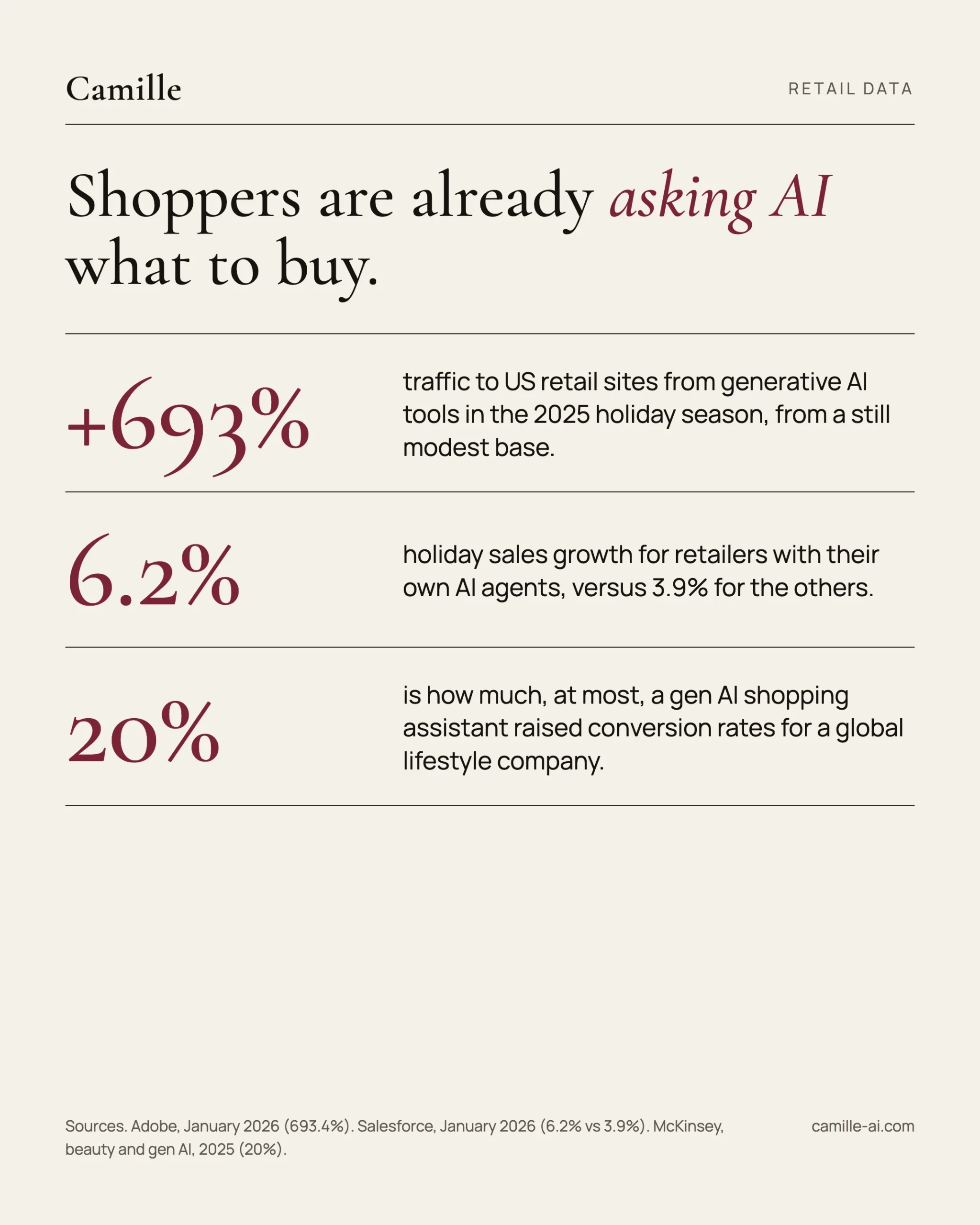
Your customers are also learning to shop this way. Adobe measured a 693.4% increase in traffic to US retail sites from generative AI tools during the 2025 holiday season, while noting that the base of users is still modest. If shoppers get used to asking an AI for advice, the question is whether that advice happens in your store or somewhere else.
Do AI shopping assistants actually increase sales?
The first published data points in that direction, but it should be read carefully. McKinsey reports that a global lifestyle company’s gen AI shopping assistant raised conversion rates by as much as 20%, and Salesforce found that retailers who deployed their own AI agents saw a 59% higher sales growth rate during the 2025 holidays, 6.2% versus 3.9% year over year.
Two warnings, from one business owner to another. First, these are large companies and their own reported figures, not controlled tests on a fashion store your size. Second, shoppers who open an assistant are often already closer to buying, so comparing them with everyone else tends to inflate the result. The numbers say the direction is right. How much it is worth in your store you only find out by measuring it on your own catalog.
What is the difference between an AI stylist and an AI personal shopper?
In practice, very little. “AI stylist” usually puts the accent on outfits and style advice, “AI personal shopper” on helping the customer buy, but both describe an assistant that recommends what to wear.
What matters more is where the advice comes from. Many AI stylist apps for consumers suggest clothes from any brand. An AI shopping assistant built for a store suggests only what that store sells, so every good piece of advice ends with a product the customer can add to the cart. Shopify describes the AI personal shopper in the same way, as an agent that helps the customer choose through conversation.
Can customers virtually try on clothes before buying?
Yes. With a photo-based virtual try-on, the customer uploads a picture and sees a realistic image of themselves wearing the item. Google explained the method when it launched its own, a model that works from two images, one of the garment and one of the person, and generates how the fabric drapes, folds and fits the pose.
On its own, though, a virtual try-on only answers “how does this look on me?” and not “which item should I choose?”. It is a fitting room without a sales associate, where the customer picks something and figures it out alone. It works best as the last step of the advice. First the assistant suggests the outfit, then the customer tries it on.
How do you stop an AI shopping assistant from making things up?
You limit what it can recommend to your own catalog. If the assistant can only suggest products that exist in your store, it cannot invent an item, a color you don’t carry or a product from a competitor.
This is the fear we hear most from store owners, and it is fair. An assistant that recommends something you don’t sell is worse than no assistant at all. Camille, the AI personal shopper we build, chooses only from the products in your catalog. She reads your catalog but does not see your customers’ orders, payments or personal data, and she does not give size advice.
Is there an AI shopping assistant for Shopify fashion stores?
Yes. On Shopify you add one as an app from the Shopify App Store, without editing your theme or writing code. With Camille, for example, you install the app, preview it privately on your own catalog and then decide who sees it.
There are four visibility modes. Admin only, customers with a tag, customers with an account, or everyone. Customers can chat with Camille in their own language and currency, and a “Try with Camille” button also appears on product pages. For WooCommerce stores we are developing a plugin.
How much does an AI shopping assistant cost?
It depends on the pricing model. Many tools charge a monthly subscription, others charge per use.
Camille works on credits, with no monthly fee and billing through Shopify. You get 300 free credits when you install. After that you can buy one-time packs of 500 credits for $19 (about 70 outfit simulations), 1,500 credits for $49 (about 170) or 3,500 credits for $99 (about 500). You only pay for what you use.
Where should you start?
The simplest way to find out if an AI shopping assistant works for your store is to try it on your own catalog, privately, before your customers see it. That way you measure the effect on your products and you decide when to open it to everyone.
Install Camille free on Shopify or try her on our demo store.
Paolo is CEO of Instamark S.r.l. and founder of Camille, the app that brings an AI personal shopper to fashion ecommerce stores. He writes about technology, conversion and the tools that help stores sell more online.
1 thought on “What an AI shopping assistant is and why your fashion store needs one”